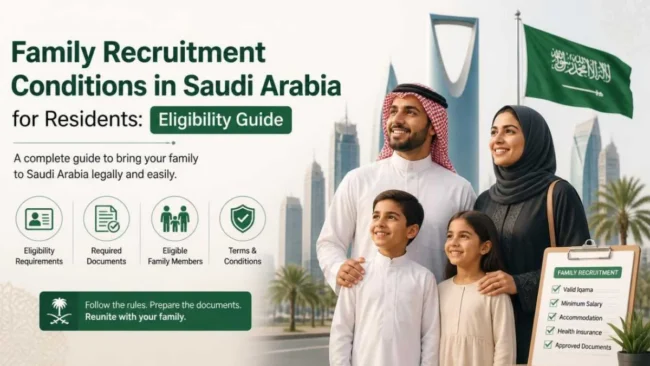
The most important family recruitment conditions are that the applicant must be a resident inside the Kingdom with a valid work Iqama, and their profession and nationality must be eligible for the service, along with proving kinship and preparing authenticated documents for the wife and children. Meeting the conditions does not mean automatic approval, as each request undergoes data verification and must comply with the controls applicable at the time of application.
This guide helps you check your eligibility before paying fees or submitting the request, and to know the cases requiring profession correction, Iqama renewal, or completing authentications. If you need to execute procedures professionally, first explore the Family Recruitment Services in Saudi Arabia provided by Al-Khaber Office.
Table of Contents
What Does Family Recruitment for Residents Mean?
Family recruitment is a procedure that allows an eligible resident to request a residency visa for close family members, primarily a wife and children, so they can enter the Kingdom and reside with him as dependents. It differs from a family visit, which grants temporary stay for the visitor and does not automatically grant them resident dependent status.
Choosing the correct path from the beginning is important because documents, fees, and subsequent procedures differ between a residency visa and a family visit. To form a complete picture before making a decision, you can read the Family Recruitment Services in Saudi Arabia: A Complete Guide from Start to Finish.
What Are the family recruitment conditions in Saudi Arabia 2026?
The resident’s eligibility relies on an interconnected set of legal and documentary conditions. The data appearing on the application platform at the time of execution must be reviewed because service acceptance may be affected by profession, nationality, residency status, and degree of kinship.
Resident Presence Inside the Kingdom
It is stipulated that the applicant must be residing in the Kingdom when using the recruitment service, and their data must be correctly registered in government systems. Submitting the request may not be possible if the beneficiary is outside the Kingdom or if their legal status does not permit using the service electronically.
Validity of Resident Identity (Iqama)
The applicant’s Iqama must be valid and not expired, and preferably not very close to expiration so the transaction does not stall during review or post-approval procedures. Also, passport and Iqama data must match the entered data without discrepancy in name, number, or date of birth.
If the Iqama validity is insufficient or nearing expiration, it is better to resolve its status before opening the transaction.
The Applicant Must Be a Resident for Work
The recruitment request is submitted by a resident holding an Iqama linked to work, not by a dependent or companion residing under another individual’s sponsorship. The occupational relationship and employer data must appear correctly during electronic verification or in supporting documents.
The Profession Must Be Eligible for Recruitment
The profession registered on the resident identity is one of the most critical elements of eligibility checking. The system looks at the official registered occupational title, not the actual work the resident performs or the title only used internally within the establishment.
Having a university degree is not enough if the registered profession is incompatible with it or ineligible for the service. To verify before applying, view the Allowed Family Recruitment Professions 2026 | Full Guide.
The Nationality Must Be Accepted in the Service
Service controls include that the applicant’s nationality must be among those allowed for recruitment. One should not rely on unofficial circulating lists because the system verifies eligibility according to the data and controls valid at the time of application.
Possessing an Active Digital Identity
The beneficiary needs an active digital identity and account to access electronic services, execute the request, or track it. The official recruitment service page on Absher clarifies that the service enables residents to submit family recruitment requests electronically, subject to profession, nationality, and residency conditions.
Proving Kinship
The relationship between the applicant and the persons to be recruited must be proven with official documents, such as a marriage contract for the wife and birth certificates for children. Names, dates, and data must match passports, with documents translated if issued in a language other than Arabic according to approved requirements.
Details vary based on the number of family members, children’s ages, and their status. To ensure basic family requirements are met, read the Conditions for Recruiting a Wife and Children in Saudi Arabia 2026: Steps and Requirements.
Family Recruitment Eligibility Checklist Table
| Verification Element | Initially Eligible Status | Status Requiring Resolution |
|---|---|---|
| Applicant’s Status | Resident inside Kingdom with work Iqama | Dependent, companion, or applicant is outside the Kingdom |
| Iqama Validity | Valid and data is correct | Expired, nearing expiration, or contains discrepancy |
| Profession | Eligible profession matching data | Ineligible profession or does not match qualification/work |
| Kinship | Wife or children with official documents | Kinship not covered or documents do not prove relationship |
| Passports | Valid and data matches | Expired or discrepancies in name and date |
| Documents | Authenticated and translated when needed | Missing, unauthenticated, or unclear |
| Electronic Account | Active digital identity and updated contact info | Unable to log in or incomplete activation |
Required Documents to Prove Eligibility
The attachment list may vary depending on the resident’s profession, nationality, and family members’ status, but the basic recruitment file usually includes the resident’s identity, work, and family relationship documents with the requested individuals.
- A clear copy of a valid resident identity.
- A copy of the applicant’s passport and family members’ passports.
- An official and authenticated marriage contract when recruiting a wife.
- Children’s birth certificates to prove kinship.
- An introduction letter from the employer showing the profession and salary.
- The educational qualification if required to prove professional specialization.
- A certified translation for documents issued in a language other than Arabic.
- Required authentications from competent authorities in the issuing country and Saudi authorities.
Missing a single document or a slight discrepancy in spelling a name may lead to the request being returned or delayed. To prepare a complete file, use the Complete Family Recruitment Documents in Saudi Arabia 2026 list.
Is There a Specific Salary to Accept Recruitment?
No amount circulated on unofficial websites should be considered a guaranteed threshold for acceptance unless it appears within official service requirements when applying. Work data, profession, income, and ability to support a family are viewed within a complete file, and verification mechanisms may differ based on the beneficiary’s case.
What matters is that the salary introduction is recent and issued by the employer, and that the profession, salary, and occupational data match official records.
How to Ensure Your Eligibility Before Applying?
An initial eligibility check can be done through clear steps. This check does not replace the competent authority’s decision, but it reduces the chances of rejection due to correctable errors.
- Review your residency status: Ensure it is a valid work Iqama and you are inside the Kingdom.
- Match the profession: Check the title registered in the resident identity and compare it to your qualification and actual work.
- Identify family members: Ensure requested persons are included in the procedure and kinship is provable.
- Check passports: Review validity, name spelling, dates of birth, and document numbers.
- Review authentications: Verify the approval of the marriage contract, birth certificates, and translations when needed.
- Prepare the work document: Obtain a recent salary introduction compatible with official data.
- Check your electronic account: Ensure digital identity activation and mobile number updates.
- Review data before submitting: Do not approve the request before matching every field with the original document.
Steps to Submit a Family Recruitment Request
After ensuring family recruitment conditions are met, the resident logs into the available platform for the service, selects the family members recruitment request, then reviews their data and adds wife and children information as it appears in their passports.
Subsequently, required fields are completed, and attachments uploaded when requested, then the beneficiary reviews the declaration and data before sending. Some requests may require authentication, additional documents, or visiting Expatriate Affairs depending on the transaction’s case. For specific details on bringing a wife, review How to Issue a Resident Wife Visa in Saudi Arabia Step-by-Step.
Upon initial request acceptance, fees and procedures related to visa issuance, family entry, insurance, medical exams, and issuing dependent IDs are completed according to instructions.
Reasons Why the Recruitment Service Does Not Appear or Submission Fails
The non-appearance of the service does not always mean a final rejection; the reason might be linked to unmet eligibility conditions or data needing an update. Common reasons include Iqama expiration, an ineligible profession, application by a dependent, or digital identity issues.
- Registered profession differs from qualification or work letter.
- Error in name, passport number, or date of birth.
- Expiration or near expiration of a family member’s passport.
- Incomplete authentication of marriage contract or birth certificates.
- Uploading an unclear image or incomplete document.
- Adding a person who does not meet the required kinship.
- Repeating a request before closing a previous transaction.
- Iqama is not valid or associated data is un-updated.
A large percentage of stalls can be avoided by reviewing the request field by field before approval.
What to Do After Submitting the Recruitment Request?
Keep the request number and any reference number appearing after submission, and do not create a new request just because the status update is delayed. Track the transaction via the designated channel and review messages and alerts to see if a data correction or extra document is requested.
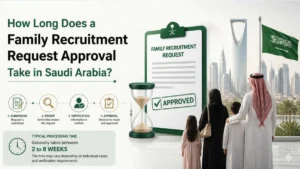
The request study duration varies from case to case based on file completeness, transaction volume, and need for additional verification. To track the status without duplicating the request, follow the guide on How to Track Recruitment Request Status via Absher. For overall expectations on processing time, read How Long Does a Family Recruitment Request Approval Take in Saudi Arabia?.
Frequently Asked Questions About family recruitment conditions
Can all residents recruit their families?
No, eligibility depends on residency status, profession, nationality, applicant capacity, kinship, and document completeness. Issuing approval remains subject to verification and the competent authority’s decision.
Is a valid Iqama alone enough for recruitment?
It is not enough on its own; it must also be a work Iqama, the profession and nationality must be eligible, family relationships must be proven, and required documents submitted correctly.
Can a companion submit a recruitment request for their family?
The standard path is for the resident holding a work Iqama eligible for the service. A dependent or companion has a different legal status and is not treated as a working resident when examining a recruitment request.
Is recruitment possible if the profession is ineligible?
Submitting or accepting a request may be impossible if the profession is ineligible. The validity of the registered profession must first be verified, and the possibility of correcting it legally studied if it doesn’t reflect actual work and qualification.
Is it required to authenticate the marriage contract and birth certificates?
Yes, authenticated documents are used to prove kinship, and they may need to be approved by competent authorities in the issuing country and Saudi authorities, with a certified translation if issued in another language.
Does meeting the conditions guarantee approval?
Meeting conditions grants the request initial eligibility and is not a final guarantee. Competent authorities verify data, documents, and applicable controls, and may request completion or correction before making a decision.
What is the difference between family recruitment and a family visit?
Recruitment aims for the wife and children to enter and reside as dependents after completing procedures, while a visit grants temporary stay for a specific purpose and duration and does not automatically convert into family residency.
Conclusion
Matching family recruitment conditions starts with work Iqama validity and the eligibility of profession and nationality, then proving kinship and preparing passports and authenticated documents without discrepancies. The more you review your file before applying, the lower the probability of delay or transaction return due to a correctable deficiency.
If you want to check your eligibility, prepare your documents, and track your request in an organized manner, reach out via our Contact Us page at Al-Khaber Public Services Office. The office’s team helps you review your case, determine the appropriate procedure according to applicable regulations and requirements, and follows up on the transaction until required steps are complete.
Leave the Procedures to Us and Save Your Time & Effort
If you need assistance completing your government transactions in Saudi Arabia, the Al-Khabeer Public Services Office team is ready to answer your inquiries and follow up on your procedures professionally.